1. Introduction to Chat and Voice Bots
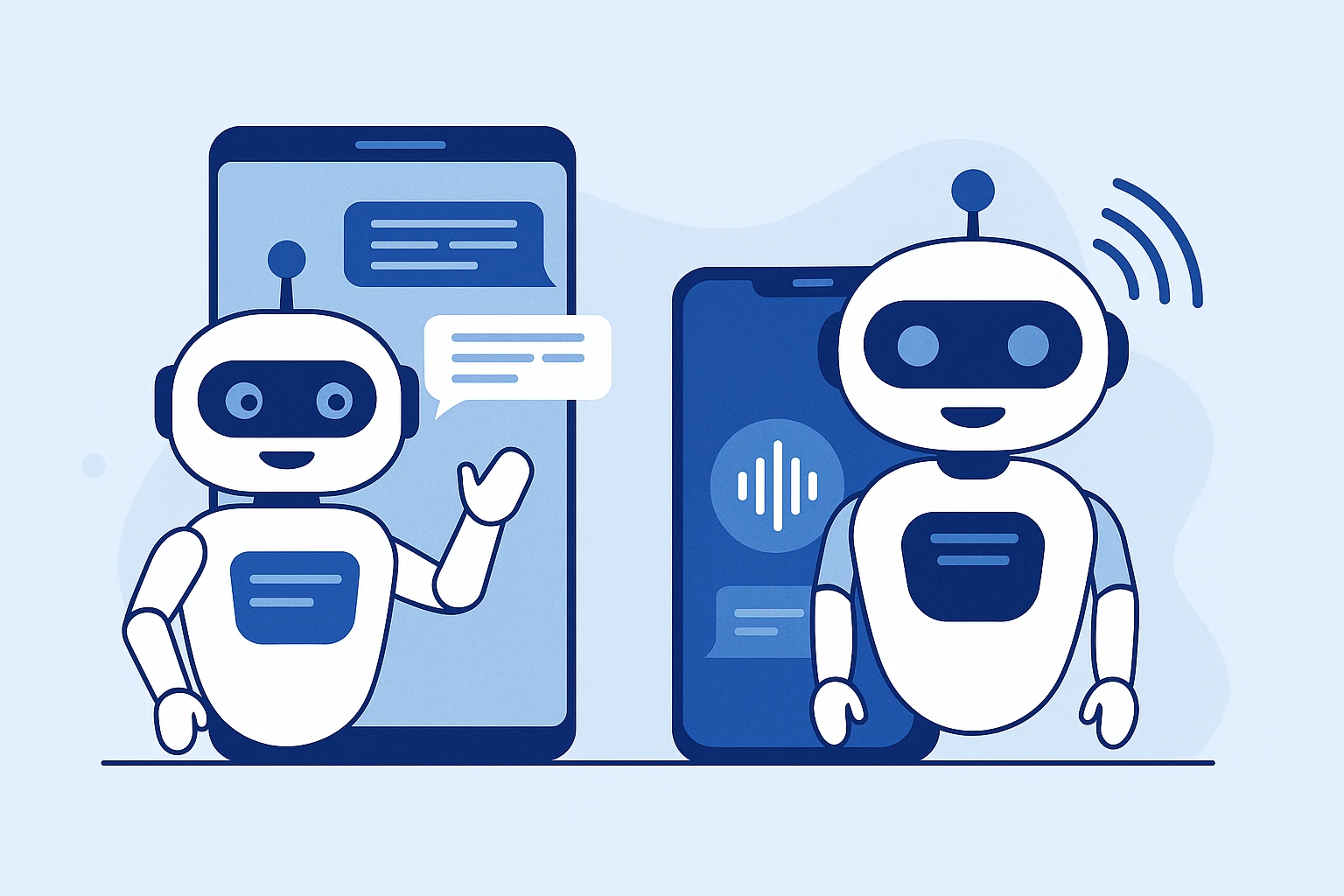
A chatbot is a computer program designed to simulate human conversation, accessible via messaging applications, websites, mobile apps, or the telephone. The newer generation of chatbots employs advanced artificial intelligence systems, including natural language processing and machine learning, to provide more realistic interactions, offer suggestions, and execute various tasks. A voice bot represents a specialized chatbot variant with added speech recognition and voice synthesis functionalities, benefiting endeavors requiring continuous availability.
The expansion of digital transformation strategies in companies creates new opportunities for intelligent automation through conversational bots. These tools often reduce costs and improve customer experience by offering support outside of standard service hours, addressing peak demand, or handling frequent, repetitive questions. The following sections examine the various types of chat and voice bots, their main advantages, the enabling technologies, design and development considerations, popular platforms, and specific use cases.
2. Types of Bots
Intelligent computer programs, known as chatbots, simulate human conversations for various purposes including customer support and education. While chatbots process text-based messages through a chat interface, voice bots utilize speech recognition to interact via spoken language. Both approaches offer continuous availability, rapid response, and resistance to negative emotions. Contemporary conversational platforms combine natural language processing (NLP), automatic speech recognition (ASR), and text-to-speech (TTS) synthesis to enable access through virtual assistants or smart speakers, thus streamlining daily routine tasks.
The principal advantages of chat and voice bots include significant cost reductions, the provision of round-the-clock automated services, and enhanced customer experiences.
2.1. Chatbots
A chatbot may be called a conversational agent or conversational bot: a computer program designed to simulate an intelligent conversation with one or more users via textual methods. In response to written requests, some chatbots simply provide standard, usually keyword-based answers; others employ more advanced, contextual speech recognition. In business, chatbots especially perform live-chat (either on a company website or in an app) functions that are often outsourced to customer-service partners: customers enter a question or a request, and a customer proxy provides an answer. The goal of those proxies is to elicit and obtain a clear statement of the user’s ultimate goal, e.g., payment of a bill, the scheduling of an appointment, so that the customer can be routed to the right person or department of the company for final execution of the request. If the user informs the partner that the user’s question or request is a simple one, then a convenient exchange of basic information is engaged in, and the conversation is terminated with thanks and an offer of further assistance. That perhaps is the logical (and least ambitious) ultimate role of chatbots in business: to outsource many of these routine conversations from expensive agents to cheaper programs, thereby reducing costs.
2.2. Voice Bots
Voice bots can be defined as conversational interfaces that utilize audio input to carry out designated tasks. When compared to chatbots, additional elements need to be considered during development, such as the connection to text-to-speech/speech-to-text backends and variations introduced by accents or noise. Moreover, the voice user interface must be designed with special attention. Voice bots extend the advantages of chatbots by providing an auditory interface and enabling voice commands. In recent years, sophisticated voice analytics, such as sentiment or wellness analysis, have become feasible.
A voice bot can be outlined as a piece of audio-based, self-service software that encapsulates artificial intelligence to endlessly serve a large number of customers at a consistently high level of satisfaction with the incorporation of a natural user experience. However, it is still necessary to distinguish clearly between a voice bot and a traditional voice menu, often known as an Interactive Voice Response (IVR) system. The latter merely enables access to a database (often a customer-relationship management (CRM) system) or a person. The voice bot further optimizes the contact center, provides a real-time dialogue with the customer, and addresses the customer’s request, and can open self-service at the deepest level.
3. Key Advantages of Implementing Intelligent Bots for Various Purposes
Recent technological advances within the fields of automation, artificial intelligence, and cloud computing have made smart bots easy to develop, test, and deploy without the need for a heavy investment in innovation, technology, skills, or infrastructure. Smart bots offer a cost-efficient way to flywheel revenues and reduce operational costs; they never sleep and can be trained, refined, and improved endlessly to keep delighting customers. The continuous advancement of NLP and speech recognition has greatly improved a bot’s ability to interact with people and help them perform useful tasks through natural, intelligent, and logical conversations.
Customers, partners, and employees expect operating companies to be connected, available, and attentive 24×7×365. They want to move beyond the traditional “dial-a-human” concept by interacting with companies naturally, through voice commands and typed text. They also prefer to go “self-service” to save time and quickly get their problems resolved by following a personal, human-like interaction. Conversing in a bot’s natural language should not feel like a limitation; if done right, it makes the process much easier and less error-prone than navigating predefined, hard-coded options hanging on a voicemail menu or a bank card’s touch-tone keyboard.
Schedule your discovery call to discuss how we can add AI Agents to your business and ask about our seasonal discounts. Schedule at https://calendly.com/mdrobes