

A digital marketing audit is a systematic review of every active online marketing channel to measure performance and alignment with your business goals. Think of it as a health check for your entire marketing operation. It covers SEO, paid ads, email, social media, content, and your technology stack. Tools like Google Analytics 4 (GA4), HubSpot, and CRM dashboards feed the data that makes the audit meaningful. Without one, you are making budget decisions based on assumptions rather than evidence.
What is a digital marketing audit and what does it cover?
A digital marketing audit evaluates all active digital channels including SEO, paid ads, email marketing, social media, and content marketing for performance and alignment. Each channel has its own failure modes and metrics, so reviewing them together reveals how well they work as a system. A weak email sequence, for example, may be masking a strong paid traffic source. The audit surfaces those disconnects.
The audit also examines your technology stack. Platforms like GA4, HubSpot, Salesforce, and ad dashboards each hold a piece of the performance picture. The audit consolidates that data into a single view. That consolidated view is what makes measurable, continuous improvement possible.

What are the main components and stages of a digital marketing audit?
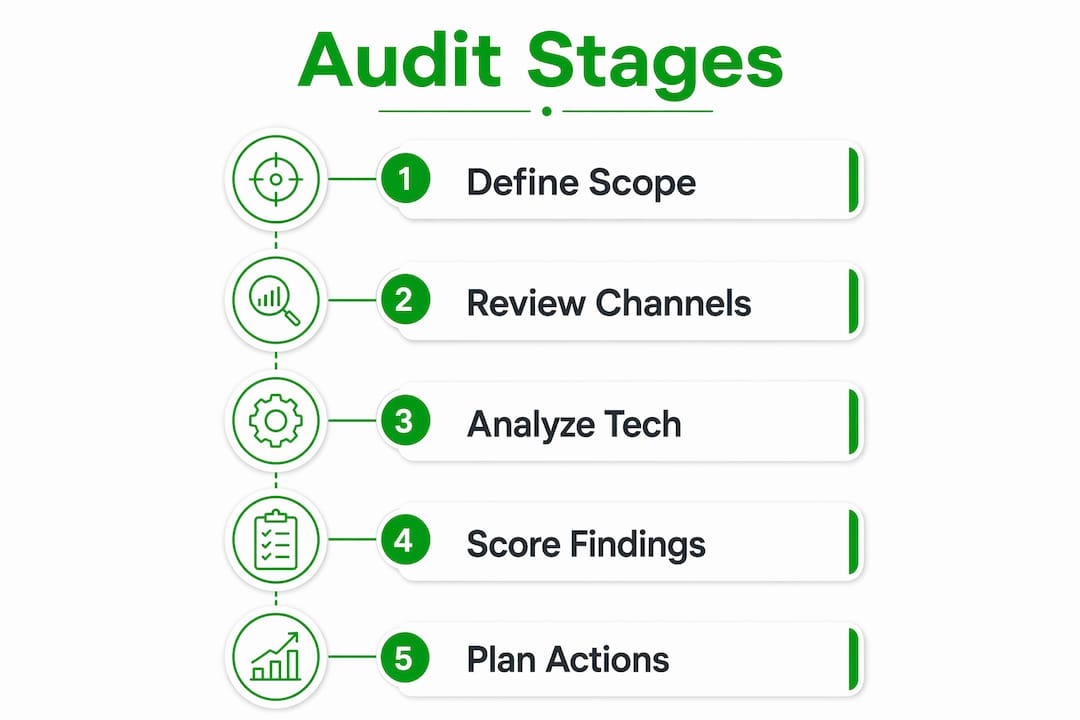
A professional-grade marketing audit follows five core stages: scope and objectives definition, channel performance review, data gathering and interpretation, competitive benchmarking, and action plan development. Each stage builds on the last. Skipping scope definition is the most common mistake, and it causes teams to audit everything without learning anything useful.
| Stage | Main activities |
|---|---|
| 1. Scope and objectives | Define business goals, channels to review, and success metrics |
| 2. Channel performance review | Evaluate SEO rankings, ad spend efficiency, email open rates, social reach |
| 3. Data gathering | Pull reports from GA4, CRM, ad dashboards, and email platforms |
| 4. Competitive benchmarking | Compare your metrics against industry benchmarks and direct competitors |
| 5. Action plan development | Build a prioritized roadmap with owners, timelines, and KPIs |
The output of a complete audit includes an executive summary, channel scorecards, a technology stack review, and a 90-day execution roadmap. The roadmap is what separates a useful audit from a report that collects dust. Without it, findings rarely translate into change.
Pro Tip: Before you pull a single report, write down the three business questions you most need the audit to answer. That list becomes your scope document and keeps the review focused.
Reviewing digital channels on a tight budget requires even sharper prioritization. Not every channel deserves equal audit depth. Allocate your review time based on where the most budget and traffic are concentrated.
Why conduct a digital marketing audit?
A thorough audit helps marketing teams pause, refocus, and realign strategies to optimize ROI by fine-tuning effective efforts and cutting waste. That is the core business case. You stop funding channels that are starting to underperform and redirect that budget toward what is actually working.
The benefits of marketing audits extend well beyond cost savings:
- Identify what works. You get clear data on which channels, campaigns, and messages drive real results.
- Reduce wasted spend. Audits expose budget going to low-return activities, from underperforming keywords to stale ad creative.
- Uncover gaps. A missing retargeting campaign or an unoptimized Google Business Profile can represent significant lost revenue.
- Improve channel integration. Audits reveal when your SEO, paid, and social efforts are pulling in different directions.
- Support data-driven decisions. Every budget conversation becomes grounded in performance data rather than gut feel.
Experts recommend quarterly checkup audits and a comprehensive full-funnel audit at least once a year to keep pace with market shifts. Audits are also triggered by specific events: a conversion rate drop, a strategy pivot, a new competitor entering your market, or a pre-budget planning cycle. Waiting for an annual review when performance has already stalled costs you months of recoverable revenue.
“A marketing audit provides visibility into messaging, tools, and budget effectiveness across all digital channels.” — Pipedrive
Connecting audit findings to a broader marketing plan aligned with business goals is what turns data into direction. The audit tells you where you are. The plan tells you where you are going.
How does a digital marketing audit differ from an assessment or quick review?
Marketing assessments are narrower, faster reviews focused on specific questions such as a pipeline decline or a customer acquisition cost increase. A full audit is comprehensive and broader. Knowing which tool to use saves your team significant time and prevents scope creep.
| Type | Scope | Time required | Best used when |
|---|---|---|---|
| Full digital marketing audit | All channels, tech stack, competitive position | 2–6 weeks | Annual review, strategy pivot, underperformance |
| Digital marketing assessment | One channel or one business question | 3–7 days | Diagnosing a specific metric drop |
| Quick review | Single campaign or recent post-mortem | A few hours | Post-campaign debrief, budget check-in |
A quick review answers “did this campaign work?” An assessment answers “why is our cost per lead rising?” A full audit answers “is our entire marketing operation aligned with where the business is going?” Each has its place. Using a full audit to answer a quick review question wastes resources. Using a quick review when a full audit is needed leaves strategic problems unaddressed.
Pro Tip: If a stakeholder asks for an audit but can only describe one specific problem, start with an assessment. You can always expand scope once you confirm whether the issue is isolated or systemic.
What are common pitfalls to avoid in a marketing audit?
Common pitfalls include unclear scope, ignoring competitive benchmarking, and failing to prioritize findings. These three mistakes account for most audits that produce reports but no real change. Unclear scope leads to data overload. Skipping benchmarking means you have no context for whether your numbers are good or bad. Failing to prioritize means the team tries to fix everything and fixes nothing.
The most damaging pitfall is trying to act on every finding at once. Trying to fix every audit finding simultaneously causes burnout and fragmented focus. Best practice limits your action plan to 3–5 high-impact tasks.
Avoid these specific traps:
- Auditing without defined success metrics for each channel
- Pulling data from platforms without confirming tracking is accurate first
- Presenting findings without an owner assigned to each recommendation
- Treating the audit as a one-time project rather than a recurring process
- Ignoring the technology stack review, which often reveals duplicate tools and wasted spend
Pro Tip: Score each audit finding on two axes: business impact and implementation effort. Focus first on high-impact, low-effort wins. They build momentum and buy-in for the harder changes.
How to implement a digital marketing audit in your organization
Implementation follows a clear sequence whether you use an internal team or an external consultant like Earningcoachmarketing.
- Define scope and objectives. List the channels, platforms, and business questions the audit must address. Tie each to a measurable goal.
- Confirm tracking accuracy. Verify that GA4, your CRM, and ad platforms are firing correctly before pulling any data. Bad data produces bad conclusions.
- Gather channel data. Pull performance reports for SEO rankings, paid ad metrics, email engagement, social reach, and content traffic. Use a consistent date range across all channels.
- Benchmark competitively. Compare your metrics against industry standards and direct competitors. Tools like Google Search Console, SEMrush, and Meta Ads Library provide competitive context.
- Interpret findings. Identify patterns. Where are conversion rates dropping? Which channels drive the most qualified traffic? Where is budget concentrated relative to results?
- Build your prioritized action plan. Limit the plan to 3–5 high-impact recommendations. Assign an owner, a deadline, and a success metric to each.
- Schedule the next audit. Set a quarterly checkup date before you close the current audit. Audit discipline compounds over time.
For teams managing SEO as part of the audit, a dedicated local SEO audit checklist adds a layer of specificity that general audits often miss. Local search performance, Google Business Profile completeness, and citation consistency are easy to overlook in a broad review.
A realistic timeline for a full audit runs two to four weeks for most small and mid-size businesses. Larger organizations with more channels and more data sources should budget four to six weeks. The measurable ROI from strategic digital marketing only materializes when audit findings drive actual execution, not just documentation.
Key takeaways
A digital marketing audit is the most direct way to identify what is wasting your budget and what deserves more investment across every channel you run.
| Point | Details |
|---|---|
| Core definition | An audit reviews all digital channels for performance and alignment with business goals. |
| Five-stage framework | Scope, channel review, data gathering, benchmarking, and action planning are the required stages. |
| Audit cadence | Run a full audit annually and a lighter checkup quarterly to stay ahead of performance shifts. |
| Limit your action plan | Focus on 3–5 high-impact tasks to avoid burnout and maintain execution momentum. |
| Audit vs. assessment | Use a full audit for strategy decisions; use an assessment for diagnosing a specific metric problem. |
Why I think most audits fail before they start
Most marketing audits fail at the scope stage, not the analysis stage. I have seen teams spend three weeks pulling data from GA4, HubSpot, and five ad platforms, only to present a 40-slide deck that no one acts on. The problem is almost always the same: nobody defined what a successful audit outcome looked like before the work began.
The discipline of writing down three specific business questions before touching any data changes everything. It forces the audit to serve a decision rather than just document a situation. That shift from documentation to decision support is what makes audits worth the time investment.
The other thing most articles will not tell you: your technology stack review will almost always reveal tools you are paying for that nobody is using. That finding alone often funds the next quarter of marketing improvements. Treat the tech stack review as a mandatory step, not an optional add-on.
Audits also work best when they are not treated as a crisis response. Teams that run quarterly checkups build institutional knowledge about their own performance patterns. They stop being surprised by seasonal drops or algorithm changes because they have the historical data to contextualize them. That is a real competitive advantage.
— Marvin
How Earningcoachmarketing turns audit findings into results
Audit findings only create value when someone acts on them. Earningcoachmarketing works with marketing professionals and business owners to implement the website, SEO, and content improvements that audits consistently surface.

If your audit reveals a website that is losing conversions, our website design and implementation service translates those findings into a site that performs. If SEO gaps are the priority, our tailored SEO strategiesaddress rankings, content, and technical structure in one coordinated plan. We also manage social media, Google Business Profile optimization, and AI solutions. The audit tells you what needs to change. We handle the execution.
FAQ
What is a digital marketing audit in simple terms?
A digital marketing audit is a structured review of all your online marketing channels to measure what is working, what is not, and where your budget is best spent. It covers SEO, paid ads, email, social media, and content.
How often should you conduct a marketing audit?
Experts recommend a comprehensive full-funnel audit at least once a year and a lighter quarterly checkup to catch performance shifts before they become costly problems.
What tools are used in a digital marketing audit?
Common tools include Google Analytics 4 for website traffic, Google Search Console for SEO data, HubSpot or a CRM for lead and pipeline data, and native dashboards for paid ad platforms like Google Ads and Meta Ads.
What is the difference between a digital marketing audit and a digital marketing assessment?
A full audit covers all channels and takes two to six weeks. An assessment is a narrower, faster review focused on one specific question, such as why cost per lead is rising, and typically takes three to seven days.
What should a digital marketing audit report include?
A complete audit report includes an executive summary, channel scorecards, a technology stack review, and a prioritized 90-day roadmap with assigned owners and measurable goals for each recommendation.