
Handling negative Google reviews professionally is crucial for maintaining your business’s reputation and local search visibility. Respond quickly, stay calm and accountable, and focus on demonstrating that you listen and are committed to resolving customer concerns. Your public replies not only address the reviewer but also build trust with all potential customers viewing your profile.
A one-star review can feel personal. The bigger risk, though, is a reply that sounds defensive, cold, or dismissive.
When you respond to negative google reviews, you are performing public customer service in front of potential customers. This interaction is a critical component of business reputation management, as it directly influences your local search rankings and determines whether a prospect chooses to contact you or moves on to a competitor.
The goal of addressing online reviews is not to win the argument. Instead, the focus should be on demonstrating that your business listens, takes concerns seriously, and handles problems with professionalism and care.
Key Takeaways
- Your reply is for the audience, not just the reviewer: Potential customers read your responses to gauge your professionalism; a calm and accountable reply can often contain the damage of a negative review.
- Prioritize speed and authenticity: Aim to respond within 24 hours and avoid robotic, copy-and-paste templates that make your business seem detached or fake.
- Follow a consistent response formula: Always thank the reviewer, acknowledge the specific issue, apologize if appropriate, offer an offline path to resolution, and close with a respectful, concise sign-off.
- Avoid public debates: Never argue, blame the customer, or disclose private account information; focus on moving the conversation to a private channel to resolve the concern.
Why your public reply matters more than the review itself
A negative review on your Google Business Profile is rarely a private exchange. It acts as a window into how your company functions when challenges arise, appearing prominently to anyone searching for your services on Google Maps.
Most readers will not know who is factually correct. Instead, they will focus on your tone. If you sound irritated, dismissive, or scripted, your online reputation will suffer. If you sound calm, specific, and fair, the damage is often contained.
This public context is why handling feedback in a timely manner is essential in 2026. Same day replies are ideal, and responding within 24 hours remains a gold standard. These consistent interactions show that your profile is active and that customer concerns do not sit ignored for days. Google also encourages businesses to avoid generic, robotic copy and paste replies.
A thoughtful answer helps your business beyond the search results page. Because online reviews are often screenshotted, shared on social media, or discussed in sales calls, one careless sentence can travel much farther than the original complaint.
Your reply is not just for the reviewer. It is for every potential customer who reads it later.
There is also a significant search visibility angle to consider. Consistent review activity, regular response freshness, and detailed engagement all support a healthy local presence. A polished website and strong on-page SEO are helpful, but poor review management can still undermine your conversion rates.
The real question is not how to defend your business from a critique. Instead, it is how to show potential customers that they can trust you, even when something goes wrong.
A simple response formula that keeps trust intact
Start with a structure. It helps your team stay steady, even when the review feels unfair.
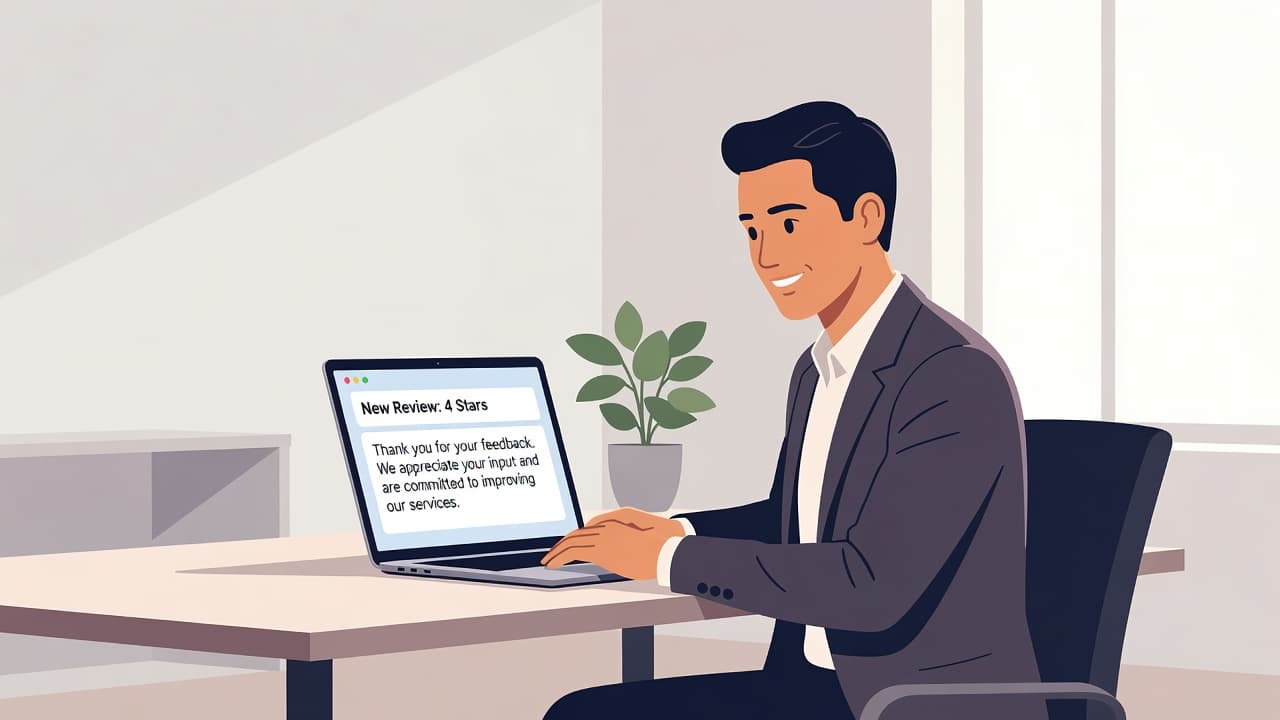
Use this five-step formula to address customer feedback in most situations:
- Thank the person for the feedback, even if the review is harsh. That lowers tension and helps you stay professional.
- Acknowledge the issue in plain language. Name the problem they described, such as a long wait, a billing mix-up, or poor communication.
- Apologize when your business likely fell short. Don’t overdo it, and don’t apologize for facts you haven’t confirmed. However, if the complaint sounds credible, take responsibility for your part in the situation.
- Offer a next step offline. Share a direct path to resolve the issue by phone, email, or a manager contact. Public replies are for building trust, but you should take the issue offline to ensure you can make things right.
- Keep the close short and respectful. Don’t pile on explanations, and do not write a mini legal defense.
Here is the kind of tone you are after:
“We’re sorry you had that experience, and we’d like the chance to make it right.”
A few things to avoid are just as important. Don’t blame the customer, don’t argue over details in public, and don’t reveal private account information. Furthermore, don’t paste the exact same reply under ten reviews. Repeated responses look fake and weaken your credibility.
This is where AI can help, but only as a draft tool. If you use AI to speed up review management, edit every reply to ensure you are sending personalized responses that sound human, match the facts, and fit your brand voice. Raw AI responses often read as stiff, vague, or overly polished. The same applies to automated reputation tools tied to chat bots or inbox workflows. Good systems save time, but trust still depends on a real human review before posting.
Strong and weak responses side by side
The difference between a bad reply and a good one is usually not length. It is defined by accountability, clarity, and restraint when addressing a customer who has had a negative experience.
Here are a few side-by-side examples.
| Situation | Weak response | Better response |
|---|---|---|
| Long wait time | “We’re always busy, so waits happen.” | “I’m sorry about the delay during your visit. That’s frustrating, and it’s not the experience we want for customers. If you’re open to it, please contact us so we can look into what happened that day.” |
| Staff complaint | “Our staff would never be rude.” | “I’m sorry to hear you felt dismissed. We expect respectful service, and we’d like to learn more so we can address it with the team.” |
| Billing dispute | “You agreed to the charge.” | “We understand billing concerns can be frustrating. We’d like to review the details with you directly and clear up any mistake or confusion.” |
| No details in the review | “Call us if you want.” | “We’re sorry to see this feedback. We don’t have enough information to identify the visit, but we’d appreciate the chance to speak with you directly and understand what went wrong.” |
The stronger replies do three things well. They recognize the customer’s frustration, avoid a public fight, and offer a solution. By maintaining a professional tone, these responses prioritize customer satisfaction and show that you are committed to long-term service improvements.
Weak replies usually fail in one of two ways. They either sound defensive, or they sound robotic. Both hurt trust. Customers can tell when a business is protecting its ego instead of addressing the issue.
If your team needs extra examples, this set of review response examples is useful for comparing tone. Use them for reference, not as a script library.
A good response should sound like it came from someone who read the review, understood it, and cared enough to answer properly.
Copy-and-paste templates for common negative reviews
Templates are excellent for efficiency, but they only build trust when you personalize them with specific details. When you respond, aim to apologize and sympathize with the customer to demonstrate that their voice is heard. These templates serve as a helpful starting point across various review sites, though you should adjust the wording to match your unique brand voice.
- For a long wait or delayed service: “Hi [Name], I am sorry about the delay during your recent visit. We know your time matters, and this was not the experience we want for our customers. Please contact us at [phone/email] so we can review what happened and make things right.”
- For a product or service quality complaint: “Hi [Name], thank you for sharing this feedback. I am sorry the result did not meet your expectations. We would like to learn more about your experience with our online reviews or product quality to see how we can resolve it. Please reach out to [contact method].”
- For a complaint about rude service: “Hi [Name], I am sorry to hear that your interaction felt disrespectful. That is not the standard we expect from our team. If you are willing, please contact [manager/contact] so we can look into this further and make things right.”
- For a vague one-star review with no details: “Hi [Name], we are sorry to see this feedback. We take customer concerns seriously, but we do not have enough information to identify your specific experience. Please contact us at [phone/email] so we can understand what happened and help.”
Keep the wording simple. A short, honest reply is almost always better than a polished one. A response that sounds natural builds far more trust than one that sounds like it was written by an attorney.
Also, do not promise specific outcomes until you have investigated the issue. Say that you will review, investigate, or follow up. Do not promise a refund or commit to disciplining an employee in a public forum unless you have already established the facts.
When to flag a review, when to reply, and how to handle 2026 realities
Not every negative review should be contested. Some require a professional response, some should be addressed by choosing to report inappropriate reviews, and a few necessitate both actions.
As of 2026, Google still does not remove reviews simply because they are negative or perceived as unfair. If a post appears fake, abusive, off-topic, or violates standard guidelines, use the official process to report inappropriate reviews through Google’s review management tools. You must first verify your business before you can reply to any feedback, and since removal requests can take time, you should not build your strategy around the hope that the review will disappear.
If the review might be authentic, reply first. If it clearly looks false but remains harmless, a short factual response can still help maintain your reputation. A reply such as, “We cannot locate a record matching this experience, but we would like to learn more if you contact us directly,” protects trust without escalating the situation.
What you should avoid is panicking and flooding your profile with a sudden surge of new review requests. Google tends to favor a steady, natural flow of feedback over sudden spikes, and offering incentives for reviews remains against company policy. Keep your request process consistent through email, SMS, and post-service follow-up.
This is where your internal operations become critical. Every business owner should assign one clear point of contact to manage customer reviews. Track your response times, tag specific complaint themes, and connect review issues to front-desk logs, service notes, and customer history. To truly improve customer experience, ensure that any voice receptionists capture complaint details accurately. Similarly, if your website chat bots collect customer feedback regarding service issues, route those transcripts to the same team responsible for managing your reviews. A centralized system reduces the risk of providing sloppy or inconsistent replies.
For businesses juggling reviews, messaging, and lead follow-up, a short No-cost discovery call can help map the process. If you already know you need tighter workflows across your profile, website, and customer communication, you can also Schedule Call.
Frequently Asked Questions
Should I ever delete a negative review?
You generally cannot delete a review yourself; you can only flag it to Google if it violates their policies, such as being abusive, off-topic, or fraudulent. Do not rely on removal, as the process is slow and often unsuccessful; it is better to provide a professional response that demonstrates your commitment to quality.
How long should my response be?
Keep your response short and to the point. A concise, sincere reply is much more effective than a long-winded legal defense, as it shows you are focused on solving the customer’s problem rather than arguing over details.
Can I use AI to write my responses?
AI can be a helpful tool for drafting, but you must edit every response to ensure it sounds human, acknowledges specific facts, and aligns with your brand voice. Raw AI-generated text often feels stiff or generic, which can actually harm your credibility if it is obvious that a human did not review the feedback.
What if I cannot find the customer in my records?
If you cannot identify the person, state that clearly and professionally in your reply. A response like, “We do not have a record of this visit, but we would appreciate the chance to learn more and clear up any confusion,” protects your reputation without admitting to a mistake you did not make.
Conclusion
A negative review does not destroy trust on its own. Often, it is the response that shapes how potential clients perceive your brand.
When you reply with calm language, specific acknowledgment, and a clear next step, you demonstrate that your business is accountable. These publicly posted responses allow future customers to see how you handle conflict, which is a vital factor in building long term customer loyalty. Your Google Business Profile serves as a direct window into your operations, and every interaction there contributes to your overall online reputation.
Ultimately, the best reply is rarely the smartest sounding one. It is the one that feels fair, human, and ready to solve the problem, proving that your commitment to quality extends far beyond your five star ratings.