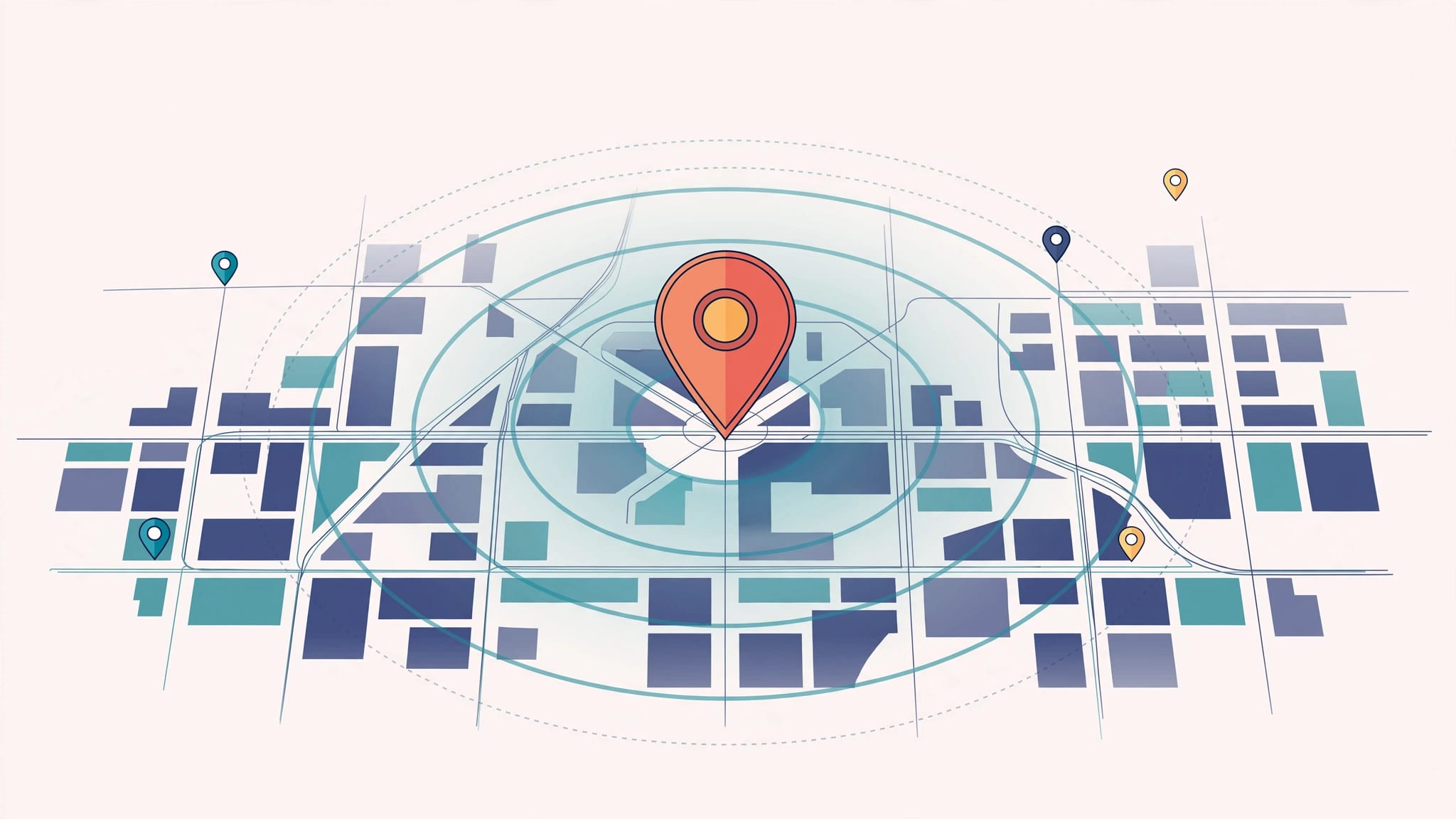
Local search rankings depend heavily on Google proximity, which connects a searcher’s location with a business address, but also factors in relevance, prominence, and service areas. While proximity bias shapes local map pack results, a comprehensive local SEO strategy focusing on accurate profiles, authentic reviews, and targeted service pages ensures stronger visibility across multiple neighborhoods. Understanding and measuring these dynamics helps set realistic expectations beyond just your business address.
A local business can rank well near its address, then fade from the map pack and local organic results a few miles away. That’s the practical reality of Google proximity in local search, where map results can vary by searcher location and query.
Your address matters, but it isn’t the entire story. Relevance, prominence, service areas, and searcher location interact across these results. Proximity searching reveals those shifts, while a smart local SEO strategy strengthens the visibility evidence you can control and sets realistic expectations for the rest.
How Proximity Works for Local Results
Proximity connects the searcher’s physical or estimated location, the place named in the search query, and the business’s verified location. It helps explain local search intent, including hyperlocal intent, but local search also reflects other signals.

Distance follows the searcher
For a “near me” search, Google can use the searcher’s current or estimated location. For a search such as “roof repair in Edison,” it can also use the location named in the search query.
These inputs can affect the local map pack, standard Google Maps browsing, and local organic listings in different ways. A local pack result may change even when the business address doesn’t.
Google’s local ranking guidance confirms that distance is a major local ranking factor. If Google can’t determine a user’s precise location, it uses the location information available to it.
A plumber can appear in the local pack for someone two blocks away and fall below competitors for someone across town. That pattern reflects proximity bias, a proximity factor tied to search context rather than a changed address. Proximity searching, such as a proximity search from different locations, helps you observe changing results; it isn’t a ranking tactic.
A service area doesn’t move your ranking point
Adding cities or ZIP codes to a service area helps customers understand where you travel. It communicates coverage, not additional locations in your Google Business Profile, and won’t make your business nearby everywhere.
Proximity operators aren’t a documented control businesses can use to manipulate Google’s local rankings.
Use service areas honestly. A service-area business should only identify places it can serve in a reasonable, consistent way. Fake offices, virtual addresses, false locations, or duplicate profiles can create compliance problems and damage visibility far more than proximity ever could.
Why Google Uses Proximity Bias
Proximity bias reflects the convenience at the heart of local search. Someone searching for an emergency electrician at 8 p.m. usually needs an available provider nearby, not one across the metro area.
Local intent can be hyperlocal
Mobile searches often carry strong location signals, giving the query hyperlocal intent. Two people searching for the same service from different neighborhoods may see different results.
What people call proximity bias isn’t a standalone formula. Distance is one proximity factor, working with relevance, prominence, searcher location, service availability, and competition density.
This helps customers, but it can feel limiting for a local business. The goal isn’t to fight proximity with shortcuts. It’s to earn visibility across the areas where your business can compete through consistent local SEO.
Results vary by neighborhood
One manual search from an office computer is only one data point. Use neutral, repeatable proximity searching from multiple points to compare nearby areas.
These proximity search observations are directional, not official ranking data. One search can’t represent an entire market, including surrounding neighborhoods, suburbs, or nearby cities.
Competitors may have a stronger presence in one part of town because they’re closer, better known, or more relevant to the query. That variation is why local rank tracking should sample neighborhoods, not just your business address.
A top-three result at your business address doesn’t prove top-three visibility across your service area.
Relevance, Distance, and Prominence Work Together
Google does not rank businesses on distance alone; its documented framework combines relevance, distance, and prominence. In local SEO, proximity is one proximity factor among several local ranking factors. Proximity bias can influence results, but stronger relevance or prominence doesn’t guarantee visibility against a closer competitor.
Service pages and links can support organic search visibility through search engine optimization. Map results also depend on profile data, distance, and prominence.
Relevance tells Google what you do
Relevance depends on how clearly your profile and website match a search. Your primary category, services, business description, hours, photos, and linked pages all help Google understand your offer.
A vague profile makes this harder. A home services company using only “contractor” may miss opportunities where a more accurate category and detailed service information better match customer searches.
Review your Google Business Profile services and match them to the services described on your website. Clear information helps Google connect the right business with the right local search. Schema markup can clarify page or business information, but it can’t substitute for relevance or prominence.
Prominence builds competitive strength
Prominence is Google’s term for how well-known and trusted a business appears. Google says links to your business and customer reviews can support local rankings. Accurate information and entity strength add supporting evidence for your online reputation, but no single signal guarantees visibility.
More positive reviews may help. Natural review language diversity can reflect genuine customer experiences, but reviews don’t replace a weak category, outdated hours, or an irrelevant service page.
Proximity searching across neighborhoods can show how competition density affects visibility. Use proximity search to compare patterns, not to promise a fixed position.
Build prominence through real work:
- Ask every eligible customer for an honest review after the job is complete, without requesting scripted wording.
- Earn local links through community involvement, partnerships, suppliers, and useful local resources.
- Keep your name, address, phone number, and hours consistent across your website and trusted directories.
- Publish service pages that explain your experience in the markets you genuinely serve.
Unstructured citations, such as a local news mention or a partner’s vendor page, can also make your brand easier for people to find and verify. Unlike structured directory listings, these community references vary in impact, so prioritize relevance and accuracy over volume.
What the Vicinity Update Changed
The industry-labeled change was observed between November 30 and December 8, 2021. It brought more attention to proximity bias, including how a proximity search can make distance more influential in local search.
Proximity appeared to carry more weight
Industry analysis, including Sterling Sky’s Vicinity Update coverage, reported signs of stronger proximity bias, with proximity searching becoming more sensitive to the searcher’s location. Some businesses saw their geographic reach tighten, while closer competitors gained visibility. That suggests a stronger proximity factor, not proof that proximity bias alone controls rankings.
Google has not published a detailed formula or a fixed distance radius. Treat claims about exact proximity weighting as estimates, not confirmed policy.
Keyword-heavy names became less reliable
Industry observers also reported that keyword-rich business names appeared less influential after the update. That doesn’t mean a real business name no longer matters. It still supports recognition and compliance, but keyword stuffing isn’t a reliable SEO strategy.
Use your real-world business name. Focus your effort on accurate information, quality service, a helpful website, and a reputation customers can verify.
How to Improve Visibility Beyond Your Address
You cannot control where a customer stands when they search. Proximity bias affects which businesses enter the results, but you can improve whether Google sees your business as a strong match.
Make your profile complete and current
A Google Business Profile is often the first place a customer evaluates your business. Complete information can improve matching and customer confidence, but it can’t guarantee visibility at every distance.
Keep these details current:
- Choose a primary category that describes your main service, then add only accurate secondary categories.
- List real services with plain-language descriptions that match your website and customer needs.
- Update holiday hours, booking details, phone numbers, and photos before customers find an error.
- Reply professionally to reviews, including critical feedback, to protect your online reputation without revealing private customer information.
Ongoing Google Business Profile optimization strengthens relevance, prominence, and customer confidence. It supports local SEO without promising visibility across every nearby area.
Build pages that prove local experience
If you serve several cities, your local SEO strategy should account for competition density and hyperlocal intent. Distinct location landing pages can document actual service availability, relevant projects, testimonials, licensing details, and clear contact paths.
Avoid cloned pages that swap one city name for another. Thin location pages create a poor customer experience and give Google little evidence to treat them as useful.
Social media can support a local business’s brand awareness and offer another verification point. Consistent evidence across your website, profile, reviews, and third-party references builds entity strength, while relevant unstructured citations add context. More citations or social media activity don’t replace strong local pages, reviews, or accurate business information.
If local visibility is inconsistent or map rankings have stalled, call for help with your local SEO challenges. An audit of profile accuracy, competitors, service pages, and geographic tracking can identify the gaps worth fixing first. You can also Schedule Call to discuss the next steps with our team.
Measure Geographic Visibility, Not One Ranking
A local ranking report should show how visibility changes across a real market. A local ranking grid is a set of sampled points around that market. For a single-location business, the local ranking grid may surround the office, while a multi-location company may track each service area separately.

Start with a clear baseline
Before changing categories, content, or review processes, record your starting position. Track the search query, grid points, date, top competitors, and current map positions.
Two metrics help make the report useful:
| Metric | What it shows |
|---|---|
| Average map position | Typical placement across all tracked grid points |
| Area of strong visibility | Neighborhoods where your business consistently appears near the top |
Neither metric is an official Google ranking score. Together, they show how proximity bias, the proximity factor, and other local ranking factors may shape local map pack visibility.
An improving average position is helpful, but broader coverage can matter more when you serve multiple neighborhoods. In local SEO, proximity searching reveals how local search results shift by neighborhood and hyperlocal intent. Pair map visibility with organic search traffic, calls, form leads, direction requests, and booked jobs.
Use tools as observation systems
BrightLocal and Whitespark are common options for tracking local rankings across geographic grids. Their grid workflows model a proximity search from multiple points, revealing patterns that a single Google Maps check can miss.
Whitespark can support workflows that combine grid tracking with manual searches, while a spreadsheet offers a simpler comparison process. BrightLocal’s reports and Whitespark’s results are third-party observations, not official Google ranking data. Results can vary with device, location precision, personalization, competition density, query wording, and service-area relevance.
You don’t need expensive software to begin. Google Search, a map app, and a spreadsheet can create a basic starting point. Record results consistently, then upgrade your tracking when the data supports a larger investment.
AI tools, chat bots, and voice receptionists aren’t ranking tools, but they can help convert the attention your visibility earns. Fast, reliable responses make it easier for nearby prospects to reach your team when they’re ready to call or book.
Key Takeaways
- Proximity reflects where the searcher is, or the place named, relative to the business address.
- Proximity bias mainly affects the map pack, while organic search follows different signals.
- A broader service area doesn’t change your physical ranking location or justify a second listing.
- Proximity searching across a grid reveals neighborhood-level strengths and weak spots that one search can’t show.
- Accurate profiles, useful pages, authentic reviews, and legitimate local references support durable visibility without guaranteeing rankings.
Frequently Asked Questions
Can a business rank in a neighboring city?
Yes, it can gain local search visibility in neighboring-city results, especially when its services are relevant and its overall presence is strong. However, that doesn’t guarantee a citywide ranking.
Closer competitors, service availability, relevance, prominence, and competition density can all change results. A business might appear in one neighborhood but not another, even within the same city.
Focus on cities you truly serve. Build useful, distinct location pages and use proximity search to test visibility by neighborhood instead of assuming one ranking applies everywhere.
Does hiding an address hurt a service-area business?
Not if customers don’t visit your location. A pure service-area business should follow Google’s guidelines and keep its street address hidden from the public.
Hiding an address doesn’t create a distance advantage. Google can still verify the business address, so keep service areas realistic, maintain an accurate profile, and avoid virtual offices or false locations.
Do reviews help overcome proximity?
Reviews can improve customer trust and strengthen an online reputation, which may support prominence, but they don’t erase distance. A business with strong reviews can still lose a local pack position to a closer, highly relevant competitor.
The better approach is consistent review growth, accurate profile management, and local content that supports the areas where you want qualified leads. Use proximity searching to observe visibility across neighborhoods over time. For a practical plan built around your market, schedule a No-cost discovery call.
Make Proximity Part of a Smarter Local Strategy
Google proximity will always shape local search rankings because customers want nearby, relevant options. Proximity bias reflects the interaction of distance, relevance, prominence, searcher location, service areas, competition, and the proximity factor. Strong businesses accept those limits and improve what they can control.
Build a clear business profile, strengthen your reputation, and create useful local pages. Use local SEO to measure visibility across the market, keeping Google Maps observations separate from local results and organic visibility. Better local visibility starts with better local evidence, not a different address.